Our Location
Shajing, Shenzhen, China
Our Location
Shajing, Shenzhen, China
When launching or expanding a disposable vape brand, one of the first manufacturing decisions is whether to choose an OEM or ODM model.
The difference affects product customization, development time, minimum order quantities, upfront costs, and how much control you have over the final product.
For wholesalers, distributors, and private-label brands, neither model is automatically better. The right choice depends on your budget, sales volume, target market, and long-term brand strategy.
This guide explains the practical differences between disposable vape OEM and ODM manufacturing and what buyers should consider before placing an order.
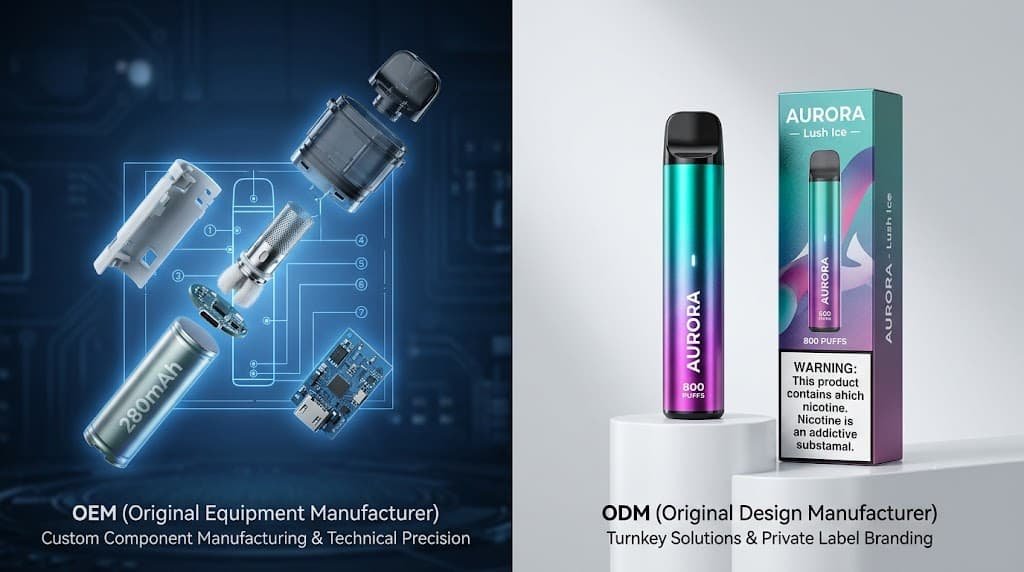
OEM (Original Equipment Manufacturing) generally refers to producing a product according to specifications provided or controlled by the brand or buyer.
In a disposable vape project, OEM development can involve a higher level of customization than a standard catalog product.
Depending on the manufacturer, customization may include:
The exact level of customization depends on the manufacturer’s engineering capabilities, tooling arrangements, MOQ, and project requirements.
OEM can therefore be a suitable option for established brands that want greater control over product design and differentiation.
OEM is worth considering when you:
However, OEM development normally requires more planning than ordering an existing product.
ODM (Original Design Manufacturing) generally means that the manufacturer provides an existing or developed product platform, while the buyer purchases it under its own brand or with selected customization.
In the disposable vape market, an ODM project may allow buyers to choose from existing product configurations and customize selected elements.
Depending on the supplier, these options may include:
This approach can reduce development requirements and allow a brand to enter the market more quickly.
However, ODM products may be less unique because other customers may have access to similar hardware.
| Factor | OEM | ODM |
|---|---|---|
| Product development | More buyer-specific | Based largely on existing manufacturer designs |
| Customization | Generally higher | Usually more limited |
| Tooling | May require new molds or tooling | Existing tooling may be available |
| Development time | Usually longer | Usually shorter |
| Initial investment | Potentially higher | Generally lower |
| Product differentiation | Higher potential | Lower potential |
| MOQ | Depends on project and supplier | Often more accessible |
| Best suited for | Established brands and differentiated products | New brands, distributors and market testing |
The exact MOQ, development cost, timeline, and customization options should always be confirmed with the manufacturer.
The biggest advantage of ODM is speed and simplicity.
Instead of developing every component from the beginning, buyers can start with an existing product platform and focus on branding, packaging, flavors, and market positioning.
Because the core product has already been developed, there may be fewer engineering stages before production.
This can be useful when a distributor wants to test a new product category or respond quickly to changing market demand.
Using existing tooling and product architecture can reduce some of the costs associated with a completely new product.
This makes ODM particularly useful for businesses that want to test demand before investing in a customized device.
A buyer can order samples, evaluate the product, and make a purchasing decision before committing to a more complex development project.
The biggest drawback is product similarity.
If multiple brands use the same public ODM platform, the products may look and perform similarly.
This can make differentiation through design, packaging, flavor strategy, pricing, and service more important.
OEM provides greater control over the product when the manufacturer supports the required level of customization.
A custom device can help a brand develop a more distinctive appearance, configuration, or user experience.
This can be valuable when a company already has a strong distribution network and wants a product that is less dependent on standard catalog designs.
Depending on the project, buyers may have more input into:
However, every customized specification should be evaluated for technical feasibility, cost, safety, and regulatory requirements.
A differentiated product can give a brand more opportunities to build its own product identity instead of competing only on price.
The trade-off is that OEM projects generally require more time, development work, and upfront planning.
There is no universal answer.
ODM may be the more practical starting point.
If you are still testing customer demand, an existing product can help you evaluate:
Once a product category proves successful, you can consider moving toward a more customized OEM project.
For wholesalers with an established customer network, a combination of ODM and OEM can make sense.
ODM products can provide a broader catalog and allow buyers to test new products.
OEM products can then be used for selected flagship products where differentiation is more important.
This approach avoids putting all of your purchasing budget into custom development while still creating opportunities for long-term brand building.
For an established brand with stable sales and clear product requirements, OEM can become more attractive.
The additional development investment may be easier to justify when the brand already has:
The key is to compare the expected long-term value of customization with the additional development cost and inventory commitment.
There is no universal OEM or ODM MOQ.
The actual requirement can depend on:
Similarly, development time varies from project to project.
A standard ODM product may move through sampling and production relatively quickly, while a new OEM device can require additional stages for industrial design, tooling, prototyping, testing, and production preparation.
Before starting either project, ask:
Getting these details in writing can prevent misunderstandings later.
This is one of the most important differences to clarify before an OEM project.
Do not assume that paying for customization automatically means you own every part of the resulting intellectual property.
Depending on the agreement, ownership may involve:
Before production begins, make sure the contract clearly defines who owns each relevant element and what the manufacturer can or cannot sell to other customers.
For more information about supplier evaluation, see our guide on questions to ask a vape manufacturer before placing an order.
Compliance should be considered during product development rather than after production is complete.
Different markets may have different requirements for:
An existing ODM product may already have certain documentation available, but that does not automatically mean it is compliant for every country.
OEM projects may require additional evaluation when the product structure, battery, materials, or other specifications change.
The buyer should confirm the applicable requirements for the target market and determine which party is responsible for providing the required documentation.
Both OEM and ODM can support good flavor performance.
The difference is mainly in how much control the buyer has over the product development process.
With ODM, buyers typically work with the manufacturer’s existing flavor and hardware combinations.
With OEM, there may be more flexibility to develop or specify:
However, flavor performance depends on the complete system.
The e-liquid, heating element, airflow, power output, and device structure all need to work together.
For more information, see our vape heating technology guide.
For many businesses, OEM and ODM do not have to be competing choices.
A practical progression can look like this:
Start with an existing product platform and evaluate market demand.
Track customer feedback, flavor demand, price sensitivity, and repeat orders.
Use actual sales information to determine what your customers value most.
If demand becomes stable, consider developing a more differentiated product.
Use a combination of standard and customized products to create a broader product portfolio.
This approach can help reduce the risk of investing heavily in custom development before the market has been tested.
Choose ODM when your priorities are:
Consider OEM when your priorities are:
For many wholesale businesses, the best strategy may be to use both approaches at different stages of growth.
The choice between disposable vape OEM and ODM is ultimately a business decision rather than simply a manufacturing decision.
ODM offers simplicity and a faster route to market, while OEM can provide greater customization and product differentiation.
The right model depends on your sales volume, budget, target market, product strategy, and long-term goals.
Before choosing a manufacturer, compare more than just the unit price. Review MOQ, tooling, development time, testing, compliance, IP ownership, quality control, and after-sales support.
If you are still evaluating suppliers, our disposable vape wholesale suppliers guide can help you compare the broader factors involved in supplier selection.
If you are looking for ready-to-sell disposable vape products or discussing a customized project, you can browse our disposable vape product collection or contact the GlimVape team to discuss products, samples, MOQ, and OEM/ODM requirements.
WhatsApp us
Legal Age Required: Products on this site are for adults of legal smoking age only. By accessing Glimvape, you confirm your age and consent to verification. Are you over 21 years of age?