Our Location
Shajing, Shenzhen, China

Our Location
Shajing, Shenzhen, China
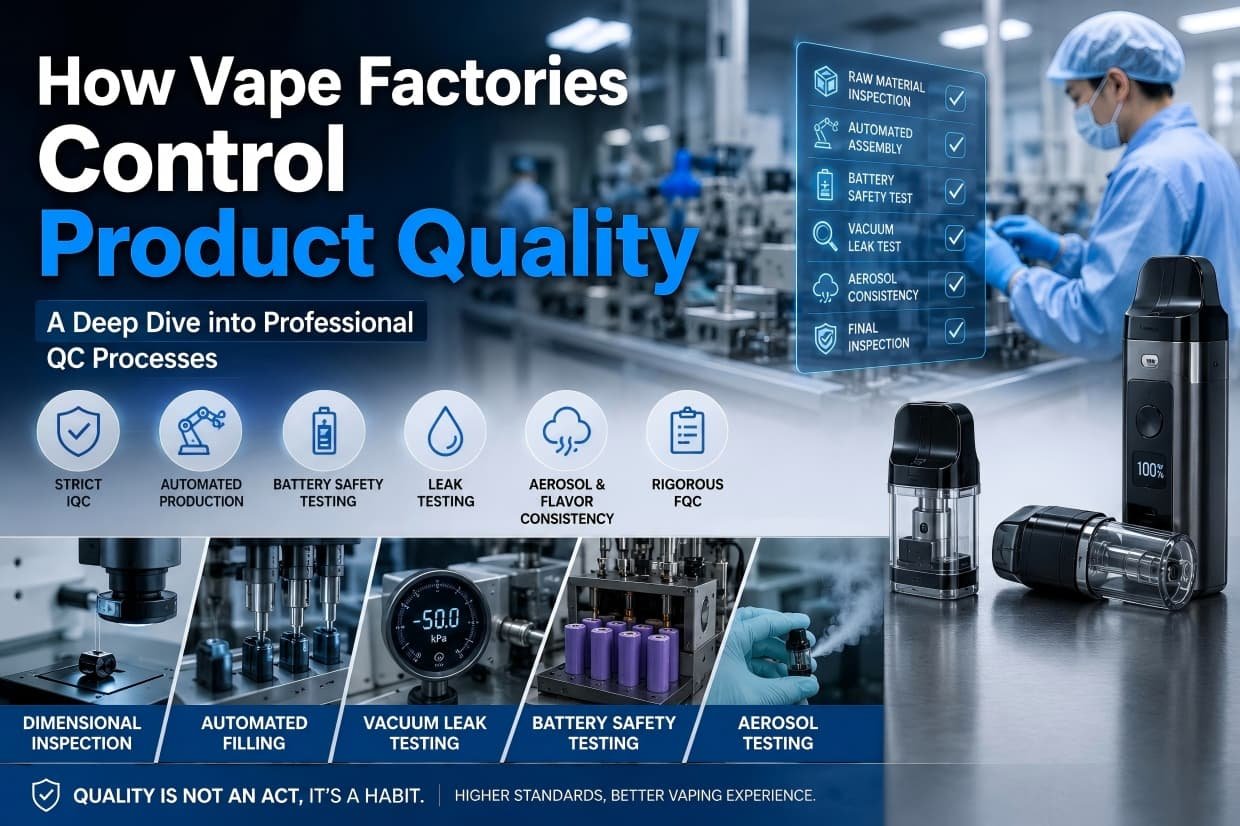
In the vape industry, product quality is closely connected to customer satisfaction, repeat orders, and brand reputation. For wholesalers, distributors, and private-label brands, choosing a manufacturer with a reliable quality management process can be just as important as comparing product price.
Quality management covers much more than a final inspection. It can include incoming material checks, production monitoring, battery testing, leak testing, functional inspection, packaging verification, and final quality control.
A well-organized process helps manufacturers identify problems earlier and maintain greater consistency between production batches.
Quality control begins before a device reaches the assembly line.
Manufacturers should inspect incoming components such as:
Dimensional and visual inspections can help identify component defects before they affect finished products.
For e-liquid and other materials, appropriate testing and documentation should be used according to the product and target market.
For buyers sourcing related products, our wholesale e-liquid selection provides another option to review.
The exact inspection method and acceptance criteria should be based on the manufacturer’s quality system and the specifications agreed with the customer.
Once materials pass inspection, standardized production procedures become important.
Modern vape manufacturing may use automated equipment, controlled production areas, and inspection stations to reduce avoidable assembly variation.
Important production controls can include:
For pod-based products, consistent sealing and assembly are particularly important because small manufacturing variations can contribute to leakage or inconsistent performance.
You can also explore our wholesale vape pod system collection to compare different product formats.
Rechargeable vape devices rely on lithium-ion or lithium-polymer batteries, making battery quality an important part of the manufacturing process.
Depending on the product design and applicable requirements, manufacturers may evaluate:
Relevant battery and transport standards may also apply depending on the market and product configuration.
However, buyers should not assume that every rechargeable vape uses the same battery specifications or protection system.
Before ordering rechargeable devices, ask the manufacturer:
Clear documentation is more useful than relying on generic claims about battery safety.
Leakage is one of the most important quality concerns for e-liquid devices.
A quality-control process may include pressure, vacuum, visual, or other leak-detection methods depending on the device structure.
Testing can help identify problems involving:
The specific testing pressure, duration, and acceptance criteria should be established according to the device design rather than applying one universal number to every product.
For wholesale buyers, it is worth asking whether the manufacturer performs leak testing on production samples and how failed units are handled.
The heating system plays an important role in flavor, vapor production, airflow, and overall device performance.
Many modern high-puff disposable vapes use mesh-based heating elements, although ceramic and traditional wire-based designs are also used.
A manufacturer’s testing process may evaluate:
Our guide to vape heating technology explains the differences between ceramic, mesh, and wire-based heating approaches.
For high-capacity devices, the coil should be evaluated together with the e-liquid formulation, airflow system, battery, and overall device design.
Product quality is not limited to physical appearance.
For disposable and closed-pod devices, consistent flavor and aerosol performance are also important.
Manufacturers may use controlled testing procedures to compare product performance between batches.
Depending on the product, testing may consider:
There is no single test procedure that applies to every vape product. Manufacturers should use appropriate testing parameters based on the device specifications and the requirements of the target market.
For brands developing customized products, testing several samples before mass production can help identify formulation or hardware issues earlier.
Final inspection provides another opportunity to identify problems before products leave the factory.
A final inspection may cover:
The inspection standard should be agreed between the buyer and manufacturer before production begins.
For manufacturers producing large quantities, checking only a few finished products is not enough.
Statistical quality-control methods can help identify recurring production problems and track changes over time.
Manufacturers may monitor indicators such as:
This data can help identify whether a problem comes from a component supplier, production process, assembly step, or product design.
The goal is not simply to pass the final inspection. It is to identify problems early and continuously improve the manufacturing process.
Before placing a large order, buyers should ask practical questions rather than relying only on marketing claims.
Consider asking:
These questions can help you understand how seriously a manufacturer treats quality management.
For additional supplier evaluation criteria, see our guide on questions to ask a vape manufacturer before placing an order.
Quality management does not end when a shipment leaves the factory.
Feedback from distributors, retailers, and end users can reveal problems that may not appear during routine production testing.
Manufacturers can use this information to improve:
For OEM and ODM projects, this feedback loop is especially useful because product specifications can be adjusted based on actual market performance.
If you are considering a customized product, our vape OEM and ODM manufacturing guide explains the broader development process.
Premium vape manufacturing is not defined by one machine, one certification, or one inspection number.
Reliable quality management is a combination of component inspection, standardized production, battery evaluation, leak testing, heating-system checks, final inspection, documentation, and continuous improvement.
For wholesalers and brands, the most useful question is not simply whether a manufacturer claims to offer “premium quality.”
Instead, ask how that quality is measured, documented, tested, and maintained from one production batch to the next.
A transparent quality-control process gives buyers a much stronger basis for evaluating a potential manufacturing partner and reducing avoidable sourcing risks.
If you are sourcing disposable vapes, pod systems, or customized products, you can browse our disposable vape product collection or contact the GlimVape team to discuss product specifications, samples, wholesale orders, and OEM/ODM requirements.
WhatsApp us
Legal Age Required: Products on this site are for adults of legal smoking age only. By accessing Glimvape, you confirm your age and consent to verification. Are you over 21 years of age?