Our Location
Shajing, Shenzhen, China

Our Location
Shajing, Shenzhen, China
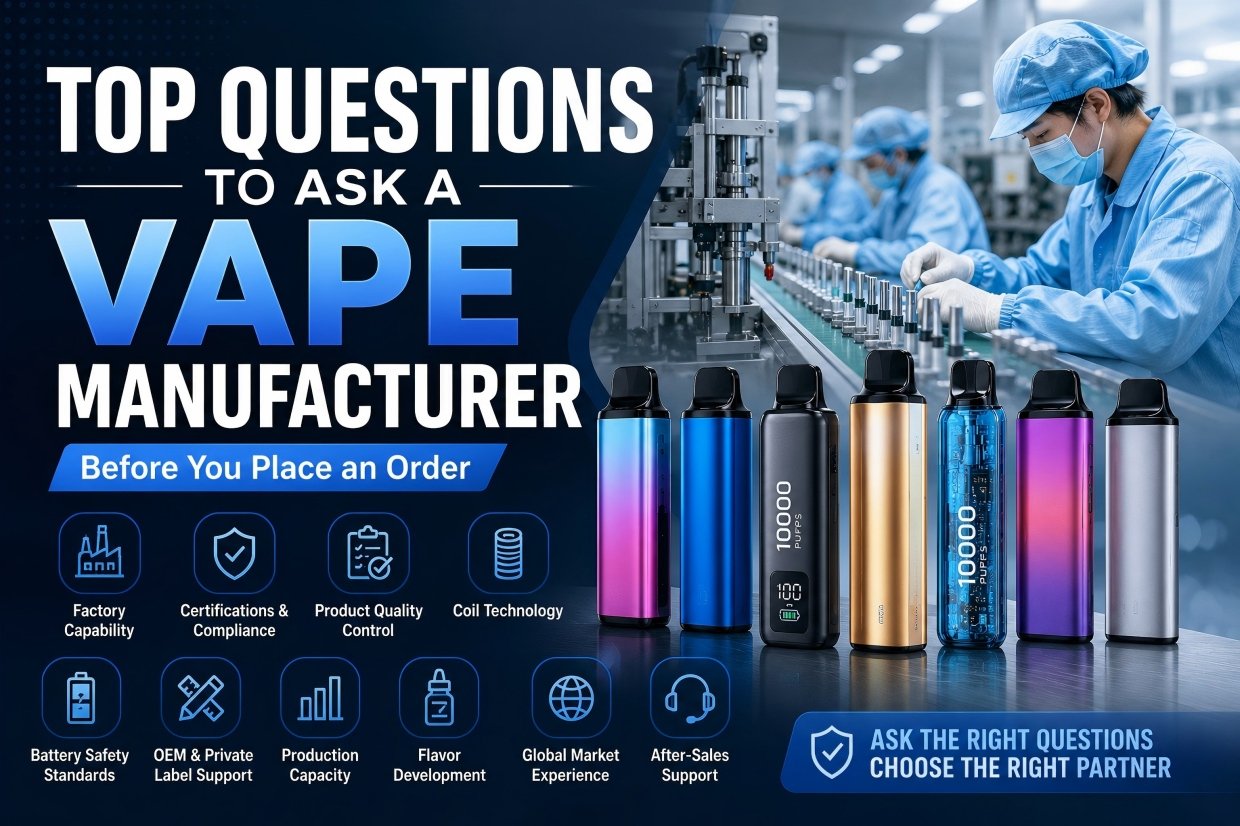
The global vape market is highly competitive, and choosing the right manufacturer can have a major impact on product quality, supply stability, compliance, and long-term business performance.
Whether you are launching a new vape brand, expanding a wholesale business, or sourcing new disposable vape products, price should not be the only factor you consider.
Before placing a bulk order, it is important to understand how a manufacturer handles production, quality control, compliance, customization, shipping, and after-sales support.
Here are the key questions to ask a vape manufacturer before you place an order.
Not every company that sells vape products is a manufacturer. Some operate as trading companies and outsource production to other factories.
The difference can affect communication, customization, quality control, lead times, and after-sales service.
A supplier with weak production controls may cause problems such as:
For wholesale buyers, these problems can affect both inventory costs and customer satisfaction.
If you are new to bulk purchasing, our disposable vape wholesale guide provides a useful overview of the sourcing process.
This should be one of your first questions.
Some suppliers operate their own production facilities, while others source products from third-party factories. Neither model is automatically unsuitable, but you should understand who actually manufactures the products you are buying.
If you are comparing several suppliers, transparency about production is a useful starting point.
Compliance requirements vary significantly between countries and regions.
Depending on the product and target market, buyers may need different technical documents, test reports, declarations, or registration information.
Do not assume that a certificate for one market automatically means the product is compliant everywhere. Always verify the requirements for your actual destination market.
Quality control is especially important for disposable and rechargeable vape products because a small production issue can affect a large quantity of inventory.
A professional manufacturing process may include inspections and testing for areas such as:
Rather than focusing only on a supplier’s claimed defect rate, ask how that rate is measured and what happens when defects are discovered.
Coil technology can influence flavor delivery, vapor production, heating behavior, and overall user experience.
Many high-puff disposable vapes use mesh-based heating elements because their structure can provide a large heating surface and support consistent heating when properly matched with the device and e-liquid.
For a deeper technical comparison, see our guide to vape heating technology.
The coil should be evaluated together with the e-liquid, airflow system, battery, and device design rather than as an isolated component.
Battery quality is an important consideration for rechargeable disposable vapes and pod devices.
Buyers should understand the battery specifications and the protection features incorporated into the finished product.
Always request the manufacturer’s charging and battery specifications rather than assuming that every USB-C vape supports the same charging conditions.
For rechargeable products, buyers should also review the manufacturer’s safety instructions before placing a large order.
If you are developing your own brand, OEM and ODM services can become an important part of supplier selection.
Depending on the manufacturer, customization may include:
For a broader overview, see our guide to vape OEM and ODM manufacturing.
OEM is not necessarily the best option for every buyer. For smaller businesses, ready-to-sell products may provide a simpler way to test market demand before investing in custom production.
A supplier may have attractive products and pricing but still struggle to maintain supply during periods of high demand.
Before placing a large order, ask about actual production capacity and typical lead times.
A reliable supplier should give you realistic timelines rather than promising delivery dates that are difficult to maintain.
Flavor selection is an important part of disposable vape purchasing, particularly for products with multiple flavor options.
If you are developing a private-label product, ask whether the manufacturer has an established flavor-development process.
For wholesale buyers, flavor selection should be based on the target market, customer preferences, regulations, and product positioning rather than simply choosing the largest possible flavor list.
A manufacturer’s previous export experience can help you understand whether they are familiar with international wholesale requirements.
Market experience does not guarantee compliance with your specific destination, but it can make communication and sourcing more efficient.
MOQ can have a significant impact on inventory risk, especially for new products.
Instead of comparing only the unit price, evaluate the complete purchasing structure.
A slightly higher unit price with a manageable MOQ may sometimes be more practical than a very low price that requires a large initial investment.
After-sales support becomes especially important when purchasing in bulk.
Before ordering, make sure both sides understand how product issues will be handled.
A clear process can prevent misunderstandings after the goods arrive.
Be cautious when a supplier:
Low pricing can be attractive, but the cheapest quotation is not always the lowest-cost option after shipping delays, defective inventory, and customer complaints are considered.
After-sales support becomes especially important when purchasing in bulk.
Before ordering, make sure both sides understand how product issues will be handled.
A clear process can prevent misunderstandings after the goods arrive.
Be cautious when a supplier:
Low pricing can be attractive, but the cheapest quotation is not always the lowest-cost option after shipping delays, defective inventory, and customer complaints are considered.
A simple supplier evaluation process can reduce sourcing risk.
Before placing a bulk order, consider this sequence:
1. Verify the supplier
Confirm the company’s business information, manufacturing capabilities, and product range.
2. Request product documents
Ask for relevant specifications, testing documents, and market-specific compliance information.
3. Order samples
Evaluate the actual product instead of relying only on photos or specifications.
4. Test the products
Check flavor, airflow, charging, leakage, appearance, and overall performance according to your market requirements.
5. Confirm commercial terms
Review MOQ, pricing, payment terms, packaging, lead time, shipping, and after-sales policies.
6. Start with a manageable order
A trial order can help you evaluate production consistency before committing to larger volumes.
For more supplier-selection criteria, see our guide on how to choose reliable disposable vape wholesale suppliers.
Choosing a vape manufacturer is about more than finding the lowest quotation.
A reliable supplier should be able to communicate clearly about product quality, compliance, production, MOQ, customization, shipping, and after-sales support.
Asking the right questions before ordering can help you identify potential risks early and choose a supplier that fits your business model and target market.
Whether you are sourcing ready-to-sell products or developing a private-label line, a careful supplier evaluation is one of the most important steps before placing a bulk order.
If you are comparing products for your wholesale business, you can browse the disposable vape product collection to review available product options.
For wholesale inquiries, samples, OEM/ODM projects, or product specifications, contact the GlimVape team to discuss your requirements.
WhatsApp us
Legal Age Required: Products on this site are for adults of legal smoking age only. By accessing Glimvape, you confirm your age and consent to verification. Are you over 21 years of age?