Our Location
Shajing, Shenzhen, China

Our Location
Shajing, Shenzhen, China
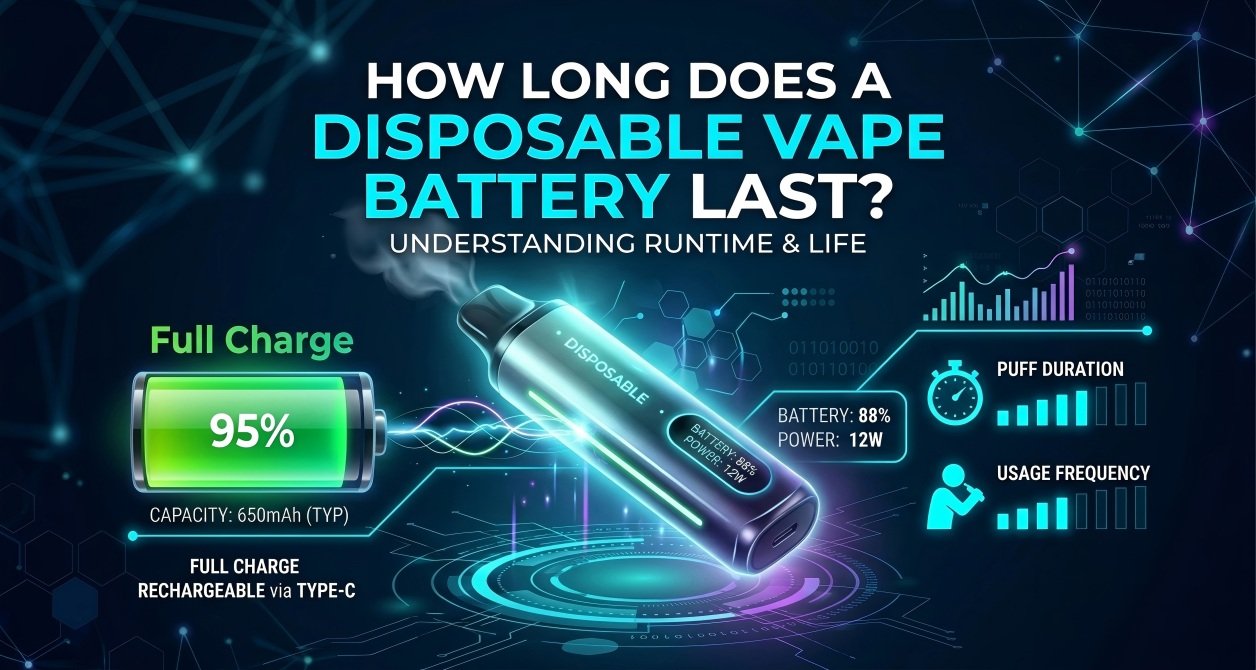
How long does a disposable vape battery last? It depends on the device’s battery capacity, power consumption, built-in features, and usage habits. Some disposable vapes use non-rechargeable batteries, while others are designed to be recharged when the battery runs low.
The key difference is between battery runtime on a single charge and the overall usable life of the device. Understanding both can help users interpret product specifications and help wholesale buyers compare products more accurately.
There is no fixed runtime that applies to every disposable vape. A battery’s performance depends on how much energy it stores and how quickly the device consumes that energy.
A larger battery may provide longer runtime under similar operating conditions. However, a device with higher power output or additional electronic features may use more energy.
Battery capacity is usually measured in milliamp-hours (mAh). Although this specification helps buyers compare devices, it cannot predict exact runtime on its own.
For a more meaningful comparison, consider battery capacity alongside power output, coil configuration, e-liquid capacity, and the manufacturer’s specifications.
It is also important to distinguish between a rechargeable device’s runtime per charge and its overall usable life. A rechargeable vape may require several charging cycles before its e-liquid is depleted, depending on its design and usage.
Several factors influence how quickly a disposable vape battery loses its charge.
Battery capacity, measured in mAh, indicates how much electrical charge a battery can store under specified conditions. A higher capacity can support longer runtime when other operating conditions are comparable.
However, capacity should not be used as the only measure of battery performance. The device’s power requirements and energy efficiency also matter.
Higher power output generally requires more energy. Devices designed for stronger vapor production may therefore consume battery power faster than lower-power models.
Coil resistance, heating structure, and operating settings can also affect energy consumption. Their impact depends on the complete electrical and heating system rather than on one specification alone.
Longer or more frequent activations generally use more battery energy. As a result, two people using the same device may experience different battery runtime.
Advertised puff counts are not a precise measure of battery life. Puff estimates depend on testing conditions, while actual performance varies with device design and usage patterns.
For a broader look at product performance and testing, see our guide on how to check disposable vape quality before wholesale.
Some newer disposable vapes include digital screens, battery indicators, e-liquid indicators, animations, or adjustable power settings.
These features can provide useful information, but their energy requirements vary by design. A screen does not automatically mean that a battery will drain quickly. Actual consumption depends on the display, electronic components, and power-management system.
For wholesale buyers, it is worth checking how these features work alongside the device’s battery capacity and rated power output.
Not all disposable vapes are rechargeable. Some are designed for single use, while others include a rechargeable battery and a charging port.
On a rechargeable model, charging replenishes the battery when its energy runs low. It does not guarantee that the device will last indefinitely or that its e-liquid will never run out.
Never attempt to charge a device that is not designed to be rechargeable, and do not dismantle or modify a vape to add a charging connection.
For rechargeable models, always follow the manufacturer’s charging instructions. Stop using the device if it becomes unusually hot, leaks, swells, or shows visible damage.
For more detailed guidance on charging compatibility, charging time, and battery safety, read our disposable vape charging safety FAQ.
You can also review the U.S. FDA’s guidance on avoiding vape battery fires or explosions for general battery-handling precautions.
The exact warning signs depend on the device. Common indicators include:
These signs do not always mean the battery has failed permanently. On a rechargeable device, they may simply indicate that the battery needs to be charged according to the manufacturer’s instructions.
If the device shows unusual heating, swelling, leakage, or physical damage, stop using it rather than attempting to repair it yourself.
Battery life and puff count are related, but they measure different things.
Battery life describes how long a battery can supply power before it needs recharging or can no longer operate the device.
Puff count is an estimate of the number of activations a device may provide under specified testing conditions. It is not a guarantee of actual usage.
A high-puff device does not necessarily provide longer runtime on a single charge. Rechargeable models may need multiple charging cycles during their usable life.
For wholesale buyers, advertised puff count should be evaluated alongside battery capacity, e-liquid capacity, power consumption, and the manufacturer’s testing information.
For distributors and retailers, battery specifications are only one part of product evaluation. A suitable product should also offer consistent performance, clear technical information, and documentation appropriate to its intended market.
Before placing a bulk order, consider the following:
Confirm the stated battery capacity and whether the device is rechargeable. Make sure the information matches the product model and its technical documentation.
Check the charging port, rated input specifications, and manufacturer’s charging instructions. A USB Type-C port alone does not establish that every charger or charging protocol is suitable.
Determine whether the display or LED provides clear battery-status information. If adjustable power settings are available, check how they affect the device’s operating requirements.
Evaluate samples before placing a large order. Compare battery behavior, charging performance, physical assembly, and overall device operation across multiple units.
For a closer look at manufacturing inspections and production standards, read our guide to vape factory quality control.
Request relevant technical specifications, battery test reports, and transport documentation where applicable. Requirements vary by product and destination market, so confirm the documents needed for the specific shipment and jurisdiction.
Do not assume that a single document automatically establishes compliance with every market’s requirements.
For additional sourcing guidance, explore our disposable vape wholesale range.
So, how long does a disposable vape battery last? There is no universal answer. Battery capacity, power consumption, device features, and usage habits all influence runtime.
For consumers, the manufacturer’s specifications provide a better starting point than advertised puff count alone. For wholesale buyers, comparing battery design, charging requirements, sample performance, and relevant documentation helps create a more complete product assessment.
Looking for disposable vape products for your business?
Contact the Glimvape team to discuss product specifications, wholesale sourcing, and OEM/ODM requirements.
WhatsApp us
Legal Age Required: Products on this site are for adults of legal smoking age only. By accessing Glimvape, you confirm your age and consent to verification. Are you over 21 years of age?