Our Location
Shajing, Shenzhen, China

Our Location
Shajing, Shenzhen, China
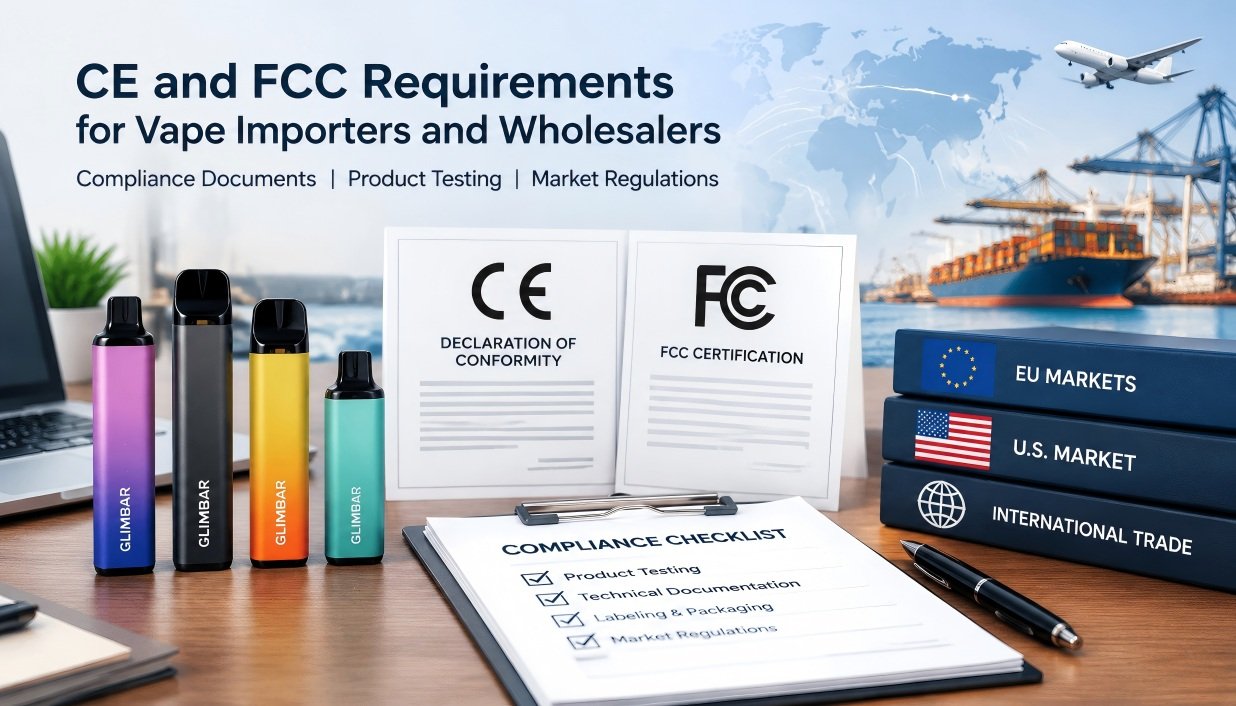
The Federal Communications Commission (FCC) regulates radio-frequency devices in the United States to help prevent harmful interference with radio communications.
Depending on its technical design, a vape device may be subject to FCC equipment authorization or other applicable requirements. Devices with wireless functions, such as Bluetooth connectivity, may require a different assessment from devices without intentional radio transmission.
Importers should confirm the applicable rules for each model rather than assuming that every disposable vape requires the same type of FCC authorization.
The FCC’s equipment authorization and importation guidance provides a starting point for evaluating applicable U.S. requirements.
| Compliance factor | CE marking | FCC compliance |
|---|---|---|
| Primary market | European Economic Area, where applicable | United States |
| Main purpose | Demonstrates conformity with applicable EU legislation | Addresses applicable U.S. radio-frequency requirements |
| Applicability | Depends on the product and relevant EU legislation | Depends on the device and applicable FCC rules |
| Supporting documentation | EU Declaration of Conformity and relevant technical documentation | Applicable authorization records and supporting technical documentation |
| Additional requirements | May include separate e-cigarette regulations and national rules | May include FDA, state, and local requirements |
CE marking and FCC compliance are not interchangeable. A product intended for both markets needs a separate assessment against the rules applicable in each destination.
Before approving a wholesale order, request documentation that identifies the exact product model and supports the supplier’s compliance claims.
For products subject to CE marking, request the relevant EU Declaration of Conformity (DoC).
Check the manufacturer’s details, product model, applicable legislation, and consistency with the actual device being supplied. A declaration covering a similar but different model should not automatically be accepted as evidence of compliance.
Request relevant laboratory test reports supporting the product’s conformity claims.
Depending on the device, these may cover electromagnetic compatibility, electrical safety, radio-frequency performance, or other applicable technical requirements.
Review the model number, test scope, manufacturer information, and report details. If the product has undergone design or component changes, confirm whether the existing assessment still applies.
Where FCC equipment authorization is required, request the relevant authorization details and supporting records.
Check whether the authorization covers the device or applicable radio module, as appropriate. A general statement from a supplier that a product is FCC compliant is not a substitute for verifying the applicable documentation.
Ask for a technical specification sheet covering the device’s main components and operating characteristics.
Useful information may include battery capacity, charging interface, electrical specifications, wireless functionality, and product identification details.
For shipping purposes, applicable lithium battery transport documentation may also be required. These transport documents serve a different purpose from CE marking and FCC authorization.
Review the proposed packaging, product labels, and user instructions before mass production.
Requirements may vary by destination market and can include manufacturer identification, health warnings, nicotine information, instructions for use, and other mandatory consumer information.
A supplier’s compliance documents should correspond to the actual commercial product, not simply an early prototype or a visually similar model.
For additional sourcing checks, see our guide on how to check disposable vape quality.
CE marking and FCC compliance do not establish that an electronic cigarette is automatically eligible for sale. Importers must also review the regulatory requirements governing the product itself.
The EU Tobacco Products Directive (2014/40/EU) establishes specific requirements for electronic cigarettes and refill containers covered by the directive.
Depending on the product and applicable national rules, requirements may include:
Manufacturers and importers may need to submit relevant product information through the European Commission’s EU Common Entry Gate (EU-CEG).
Review the European Commission’s official electronic cigarette regulations and check the rules in each intended country before placing an order.
One important consideration is that EU member states may introduce additional national restrictions. Importers should verify current requirements for their target markets rather than assuming that a single set of documents guarantees permission to sell throughout the EU.
FCC compliance does not authorize an electronic cigarette for sale in the United States.
The U.S. Food and Drug Administration (FDA) regulates electronic nicotine delivery systems under applicable tobacco-product laws. New tobacco products generally require the applicable FDA marketing authorization before they can legally be marketed.
Before sourcing inventory for the U.S. market, importers should verify the product’s regulatory status and review the FDA’s guidance on importing tobacco products.
State and local requirements may also affect product eligibility, distribution, labeling, and sales. Customs and shipping requirements should be assessed separately.
For wholesale buyers, checking market eligibility before committing to a large shipment can help reduce avoidable sourcing risks.
A reliable wholesale supplier should be able to provide clear product specifications, explain the available compliance documentation, and help buyers identify the information needed for their target market.
Use the following checklist before confirming a bulk order.
1. Confirm the exact product model.
Ensure that the quotation, specifications, test reports, and declarations refer to the same device and configuration.
2. Request relevant compliance documentation.
Ask which CE-related legislation applies, whether FCC authorization is required, and what supporting records are available for the product.
3. Verify document consistency.
Compare manufacturer details, model identifiers, technical specifications, and report information. Resolve discrepancies before approving production or shipment.
4. Identify the destination market.
Tell the supplier whether the products are intended for the EU, the United States, or another market. Different destinations have different regulatory requirements.
5. Review quality control procedures.
Ask how the supplier maintains consistency between assessed products and mass-produced units. Product changes may affect whether existing documentation remains applicable.
6. Confirm requirements before shipment.
Agree on the documents, product specifications, packaging, and inspection procedures required for the order.
When comparing different product options, explore our multi-flavor disposable vapes to discover available models and flavor combinations for your wholesale business.
You can also review our disposable vape wholesale options when comparing products for your distribution business.
Vape importers and wholesalers should avoid several common mistakes when evaluating products and suppliers.
A structured compliance review helps importers identify potential issues earlier and make more informed purchasing decisions.
No. CE marking is required only when a product falls under applicable EU legislation that requires it. The relevant legislation and conformity assessment must be determined for the specific product.
Not necessarily. FCC obligations depend on the device’s technical characteristics and applicable rules. Importers should verify whether the specific model requires equipment authorization or other compliance measures.
No. Where applicable, electronic cigarettes must also comply with relevant tobacco-product regulations, notification procedures, packaging and labeling requirements, and national rules.
No. FCC requirements are separate from FDA requirements and other applicable rules governing electronic cigarettes. Importers should verify that a product meets the requirements for the intended U.S. market.
Depending on the product and market, request relevant declarations of conformity, technical specifications, applicable test reports, FCC authorization details where required, and information about packaging, labeling, and market-entry requirements.
CE and FCC compliance are important considerations for vape importers and wholesalers. Before placing a bulk order, verify the applicable regulations, product documentation, and market-entry requirements for your target market.
Looking for reliable disposable vape wholesale options? Explore our product range and contact us to discuss your sourcing needs.
Disclaimer: This article provides general information only and does not constitute legal advice. Always verify current requirements before importing or distributing vape products.
WhatsApp us
Legal Age Required: Products on this site are for adults of legal smoking age only. By accessing Glimvape, you confirm your age and consent to verification. Are you over 21 years of age?